
Canada Undeclared Family Members Sponsorship: Public Policy 2026
- Category:Immigration News
- Country:Canada
- View Counts:466
- Published on:03-Sep-2026
Canada Updates Public Policy for Undeclared Family Members
Canada has a special public policy that may allow certain permanent residents to sponsor family members who were not declared or examined during their original immigration application. The policy is available for eligible applications received between May 31, 2019, and September 10, 2026.
Under Canada’s immigration rules, applicants for permanent residence are generally required to declare all family members, even if those family members do not plan to accompany them to Canada. Declared family members may also be required to complete medical examinations and pass applicable background and security checks.
However, in certain circumstances, the Canadian government allows permanent residents to sponsor previously undeclared family members under a specific public policy.
Who Is Considered a Family Member?
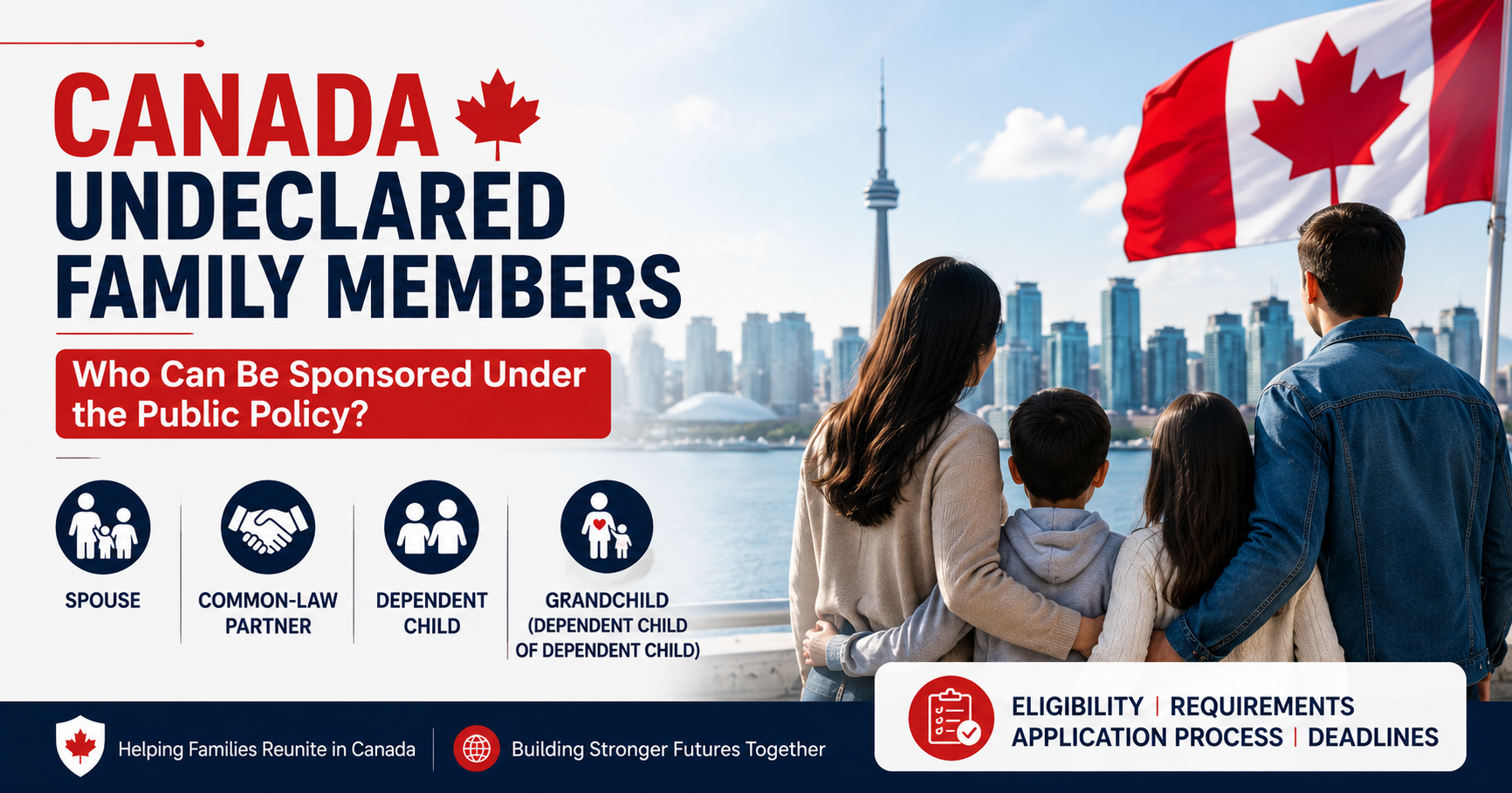
Depending on the circumstances, family members can include:
- Spouse
- Common-law partner
- Dependent children
- Grandchildren who are dependent children of a dependent child
Normally, a permanent resident cannot sponsor a family member who was not declared on their original permanent residence application. However, eligible individuals may benefit from the public policy for certain undeclared family members.
Who May Be Eligible Under the Public Policy?
A previously undeclared family member may be eligible for sponsorship if they are applying to be sponsored as a:
- Spouse
- Common-law partner
- Conjugal partner
- Dependent child
The family member must also have not been declared or examined when the sponsor became a permanent resident in Canada through certain immigration circumstances.
These circumstances may include cases where the sponsor became a permanent resident:
- As a resettled refugee, including a Convention refugee or a person in similar circumstances
- After being recognized as a protected person
- After being sponsored as a spouse, common-law partner, conjugal partner or dependent child under the Family Class
- After being sponsored as a spouse or common-law partner under the Spouse or Common-Law Partner in Canada Class
Who Cannot Be Sponsored?
The public policy does not apply to every case involving an undeclared family member.
A previously undeclared family member may not be eligible if declaring that person at the time of the original immigration application would have made the sponsor ineligible to immigrate to Canada.
For example, the policy generally does not cover situations where:
- The sponsor immigrated to Canada as a spouse but was already married to or in a common-law relationship with the undeclared person.
- The sponsor was married to or in a common-law relationship with the undeclared person when they immigrated as a dependent child on their parent’s application.
- The sponsor immigrated through a program that required them to be single and without dependants.
These restrictions are important because the undeclared relationship could have affected the sponsor’s eligibility for permanent residence at the time of their original application.
How to Sponsor an Undeclared Family Member
There is no separate application process specifically for this public policy.
Eligible sponsors should apply through the regular process for sponsoring a spouse, partner or dependent child. Immigration, Refugees and Citizenship Canada (IRCC) will assess the application and determine whether the family member qualifies under the public policy.
Applicants should ensure that all required forms and supporting documents are complete and accurate.
What If the Sponsorship Application Is Already in Process?
If an application to sponsor an undeclared family member has already been submitted and is still being processed, the applicant generally does not need to submit a new application.
IRCC will review applications that were submitted during the applicable period and determine whether the family member qualifies under the public policy.
What If the Application Was Previously Refused?
Individuals whose application to sponsor an undeclared family member was refused before May 31, 2019, may be able to submit a new application if the family member meets the eligibility requirements of the public policy.
Eligibility will depend on the circumstances of the original immigration application and the relationship between the sponsor and family member.
Important Deadline: September 10, 2026
The public policy applies to applications received from May 31, 2019, through September 10, 2026.
With the September 10, 2026 deadline approaching, permanent residents who believe they have an eligible undeclared spouse, partner or dependent child should review their circumstances and ensure that any application is submitted within the applicable period.
Important Note
Immigration rules and public policies can be complex, and eligibility depends on the individual circumstances of both the sponsor and the undeclared family member. Applicants should carefully review their immigration history, family relationship and original permanent residence application before submitting a sponsorship application.