
DCU January 2027 Intake Opens for MSc in Computing (Artificial Intelligence) and MSc in Computing (Data Analytics)
- Category:Student Visa
- Country:Ireland
- View Counts:419
- Published on:15-Aug-2026
DCU January 2027 Intake Admissions Update
Dublin City University (DCU) has announced that applications are now open for the January 2027 intake of its MSc in Computing (Artificial Intelligence) and MSc in Computing (Data Analytics) programmes.
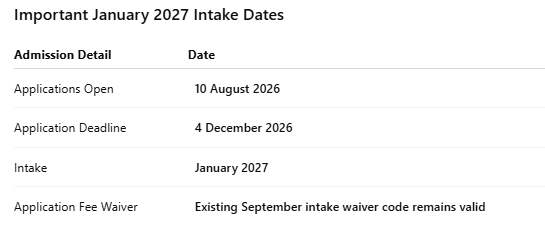
Applications for the January 2027 intake opened on 10 August 2026, giving eligible international students an opportunity to apply for postgraduate study in Ireland.
Students planning to apply are advised to begin preparing their academic documents and application well before the deadline.
Important: The application fee waiver code for the January 2027 intake remains the same code that has been used for the September applications.
MSc in Computing at DCU
The MSc in Computing is designed to provide students with advanced knowledge and practical skills in modern computing disciplines. The programme has a strong practical focus and is suitable for both recent graduates and experienced computing professionals.
Students can develop specialist knowledge in areas such as:
- Artificial Intelligence
- Data Analytics
- Natural Language Processing
- Cybersecurity
- Machine Learning
- Data Mining
- Cloud Technologies
- Software Engineering
- Advanced Computing
The programme also includes significant project-based learning, allowing students to apply their knowledge to real-world computing challenges.
Programme Structure
The programme combines taught modules with a substantial 30 ECTS practicum. Students work on projects that can involve developing software systems, analysing processes and techniques, or investigating solutions to real-world problems.
During the programme, students can develop skills in:
- Software engineering
- Operating systems and networks
- Machine learning and artificial intelligence
- Data analytics and data mining
- Research and problem-solving
- Team-based project work
- Communication and presentation
- Professional practice
- Emerging computing technologies
Artificial Intelligence
The Artificial Intelligence major includes subjects such as:
- Professional and Research Practice
- Foundations of Artificial Intelligence
- Statistical Data Analysis
- Data Analytics and Data Mining
- Machine Learning
- Artificial Intelligence, Information and Information Seeking
- Data Management and Visualization
- Statistical Machine Translation — Elective
- Mechanics of Search — Elective
- AI Practicum — 30 ECTS
Data Analytics
The Data Analytics major includes:
- Professional and Research Practice
- Statistical Data Analysis
- Cloud Technologies
- Data Management and Visualisation
- Mathematical Methods/Computational Science
- Artificial Intelligence, Information and Information Seeking
- Data Analytics and Data Mining
- Machine Learning
- DA Practicum — 30 ECTS
Natural Language Processing
The Natural Language Processing major includes:
- Foundations of Natural Language Processing
- Introduction to Machine Learning
- Professional & Research Practice
- Human Factors in NLP
- Deep Learning for Natural Language Processing
- Advanced Machine Learning
- Data Analytics & Data Mining
- Machine Translation — Elective
- Mathematical Methods/Computational Science — Elective
- NLP Practicum — 30 ECTS
Cybersecurity
The Cybersecurity major includes:
- Professional & Research Practice
- System Software
- Secure Programming
- Cryptography and Number Theory
- Formal Programming
- Concurrent Programming
- Software Process Quality
- Network Security
- SSE Practicum — 30 ECTS
Entry Requirements
Applicants should meet the university's academic and English-language requirements.
For entry to the programme, candidates are generally expected to hold a Second Class Honours degree (2.1) or higher in:
- Computer Science
- Computing
- Computer Applications
- A relevant discipline
Applicants should also be competent programmers and comfortable with mathematical concepts.
English Language Requirements
International applicants whose first language is not English must demonstrate that they meet DCU's English-language requirements.
Applicants should check the latest official English-language requirements before submitting their application.
Career Opportunities After MSc Computing
The MSc in Computing is designed to help graduates develop skills relevant to a wide range of technology careers in Ireland and internationally.
Potential career roles include:
- Software Engineer
- Computer Programmer
- IT Project Analyst
- Performance Engineer
- Python/Java Developer
- Web Applications Developer
- Business Analyst
- Technical Analyst
- Technical Consultant
- Data Analyst
DCU also highlights graduate employment with major technology companies including Google, Facebook, HubSpot, Intel, Apple, Amazon and Microsoft.
Some graduates may also choose to continue their academic careers through PhD research and further postgraduate study.
Fees and Funding
For the 2026–2027 academic year, the published tuition fees include:

Fees are charged per annum and may be subject to annual increases.
Faculty of Engineering & Computing International Scholarship
Eligible non-EU applicants who receive an offer for an eligible postgraduate programme in the Faculty of Engineering and Computing may be considered for the Faculty of Engineering & Computing International Scholarship.
Successful recipients can receive a €5,000 reduction from the full-time 2026–2027 non-EU tuition fee.
Applicants should check the latest scholarship conditions and eligibility criteria before applying.
Life at Dublin City University
DCU offers students a comprehensive campus experience with modern teaching facilities, libraries, study spaces, restaurants, sports facilities, accommodation and student support services.
The university has three academic campuses:
- Glasnevin Campus
- St Patrick's Campus
- All Hallows Campus
The campuses are located close to Dublin city centre and are connected by public transport.
DCU also offers a wide range of extracurricular opportunities, with more than 140 clubs and societies covering sports, arts, culture, technology and other interests.
Students can also access facilities including sports centres, fitness facilities, swimming pools, pitches, study areas, student hubs and the university's performing arts centre, The Helix.
Student Support
International and postgraduate students can access a range of academic and professional support services, including:
- Student Advice & Learning Skills Centre
- Writing Centre
- Maths Learning Centre
- Student Learning services
- Careers support
These services can help students adjust to university life, improve academic skills and prepare for graduate employment.
Why Consider DCU for Computing?
Studying an MSc in Computing at DCU can provide students with the opportunity to combine advanced academic learning with practical project experience.
Key highlights include:
- January 2027 intake available
- Specialisations including Artificial Intelligence and Data Analytics
- Strong practical and project-based learning
- 30 ECTS practicum
- Industry-focused computing skills
- Career opportunities in Ireland and internationally
- Access to modern university facilities
- International student support
- Scholarship opportunities for eligible non-EU students
Application Deadline: 4 December 2026
Students interested in the DCU January 2027 intake should plan their applications early. Applications for the MSc in Computing (Artificial Intelligence) and MSc in Computing (Data Analytics) opened on 10 August 2026, and the application deadline is 4 December 2026.
The January 2027 intake application fee waiver code remains the same code used for September applications.
Applicants should review the latest programme, entry requirement, tuition fee and scholarship information on the official DCU website before submitting an application.
Looking to Study in Ireland?
If you are planning to apply for DCU or other universities in Ireland, professional guidance can help you understand admission requirements, documentation, application procedures and visa requirements.
Start preparing your application early to avoid missing the 4 December 2026 deadline.