
Ireland vs Hungary: Which Is Better for International Students in 2026?
Ireland vs 🇭🇺 Hungary: Which Is Better for International Students in 2026?
Studying abroad is one of the most important decisions you’ll make as a young adult — and choosing the right country matters just as much as choosing your major. In 2026, students around the world are increasingly weighing Ireland vs Hungary as study destinations. Both offer internationally recognized degrees, compelling campus environments, and paths to employment and settlement, but their strengths differ significantly.
In this detailed guide, we compare:
1. Tuition Costs
2. Living Cost Comparison
3. Student Visa Approval Rates
4. PR & Post‑Study Opportunities
5. Work Rights During & After Study
6. Which Country Is Right for Which Student?
1. Tuition Comparison: Ireland vs Hungary
Tuition is often the biggest financial consideration for international students, and here Ireland and Hungary differ significantly.
Ireland (Higher Tuition)
Ireland’s education system is known for strong academic standards and vibrant research output. However, that quality comes at a premium:
- Bachelor’s degree yearly fees: €9,000–€22,000+ for international students.
- Master’s programmes: Approximately €9,000–€35,000+ annually.
- Specialized programmes like medicine, dentistry, and engineering often cost even more (up to €45,000–€55,000+).
Important: Scholarship programmes like the Government of Ireland International Education Scholarships provide €10,000 stipends plus full tuition waivers for select postgraduate students in 2026 — a significant financial cushion if you are eligible.
Summary:
Ireland is moderately expensive to expensive in terms of tuition compared with many European countries — worth it if funding is available or if you target high‑earning fields (e.g., tech, finance, STEM).
Hungary (Lower Tuition)
Hungary is known for very affordable education, including in fields like medicine and engineering:
- Bachelor’s and master’s degrees: Often range from €2,500 to €9,000 per year.
- Public universities typically cost €3,000–€8,000 per year for most programmes.
- Degrees like medicine might cost more (up to €12,000–€18,000 per year).
Hungary also offers competitive scholarships (e.g., Stipendium Hungaricum) that cover tuition and sometimes living costs — a major benefit for many students.
Summary:
Hungary’s tuition is significantly lower than Ireland’s, making it a strong choice for budget‑conscious students.
2. Living Cost Comparison
Tuition is only part of the story — living costs vary dramatically between countries and cities.
Ireland: One of Europe’s Higher Cost Destinations
Living expenses in Ireland are relatively high, especially in cities like Dublin:
- Estimated living cost: €1,445–€2,800 per month including accommodation.
- Shared accommodation or student housing can cost between €600–€1,200+ monthly depending on city and standard.
- Total estimated annual living costs range €7,000–€12,000+.
Despite this, Ireland often compares more favourably to the UK or US in overall student budgets — though still higher than many CEE (Central & Eastern European) countries.
Summary:
Expect higher living costs in Ireland, especially in Dublin or Cork, though quality of living and services are high.
Hungary: Much Lower Everyday Costs
Hungary has a reputation for being one of Europe’s most student‑friendly places financially:
- Average monthly cost (housing + food + transport): €400–€800.
- Rental in student housing or shared apartments: €150–€450 per month.
- Transportation and groceries are inexpensive with student discounts.
Summary:
If budget is a big factor, Hungary’s low living costs make it very attractive — you might spend half or even less compared to Ireland.
3. Visa Approval Rate: How Easy Is It to Get a Study Visa?
Visa approval is critical — a high rejection rate can derail your study plans even with great finances and qualifications.
Ireland Visa Approval
Ireland has a strong track record of student visa approvals for qualified applicants:
- Reported success rates are around 94–96% for student visa applications when correctly prepared.
- Pakistani and Indian applicant success rates are often cited near 96%.
Visa rejection usually comes from insufficient documentation or inadequate proof of funds, not academic qualifications.
Summary:
Ireland’s visa process is competitive but fair, with a generally high approval rate if requirements are properly met.
Hungary Visa Approval
While exact data is less frequently published, available information suggests high Schengen/long‑stay student visa rates:
- One widely cited statistic estimated Hungary’s student visa approval rate at about 92–93%.
- Hungary issues a resident permit for studies that doubles as a Schengen long‑stay visa in many cases.
Many students find Hungary’s visa process transparent if documentation is complete (acceptance letter, proof of funds, accommodation and insurance).
Summary:
Hungary also offers solid visa approval chances, generally competitive with Ireland — especially for well‑prepared applicants.
4. PR (Permanent Residency) & Long‑Term Opportunities
Many students aren’t just looking to study — they want to stay.
Ireland: Clear but Longer Path to PR
Ireland is attractive because it provides structured pathways from student visas to work visas and eventually permanent residency, though the timeline is substantial:
- After graduation, you can stay for up to 2 years on the Third Level Graduate Programme to find work.
- To gain Stamp 4 (long‑term residency) — essentially a step towards PR — international graduates typically need 5 years of qualifying residency and work experience.
- Once granted, Stamp 4 allows work without a permit and access to many public services.
Ireland also provides a clear path toward full citizenship after meeting residence and integration requirements.
Summary:
Ireland’s pathway to PR is well‑defined and stable, although it demands time and official employment after graduation.
Hungary: Simpler Work‑Search but Harsher Long‑Term Requirements
Hungary allows international graduates to apply for a job‑search residence permit after studies.
However:
- The Hungarian job market is smaller than Ireland’s, meaning you may have to compete harder for roles.
- Long‑term stays and PR pathways are less internationally publicized and generally more stringent than in Ireland, with few straightforward routes unless you secure employer sponsorship or qualify under other immigration policies.
Summary:
Hungary’s post‑study opportunities exist but are often more limited and depend strongly on language skills and job availability.
5. Work Rights: On Campus, Off Campus & After Graduation
Work experience is vital for finances and employability.
Ireland Work Rights
Under Irish student visas:
- Non‑EU students can work up to 20 hours per week during term and 40 hours per week during holidays.
- After graduation, the Third Level Graduate Programme allows full‑time work for up to 2 years.
- Work experience in Ireland counts toward eligibility for long‑term employment permits and PR.
Summary: Ireland provides excellent work rights, supporting students financially during study and strengthening career prospects after graduation.
Hungary Work Rights
Hungary also allows international students to work:
- Students may typically work up to 24 hours per week during studies and full‑time in breaks.
- After graduating, you can apply for a job‑search permit, but long‑term residency hinges on securing employment and meeting immigration thresholds.
Summary:
Hungary’s student work rights are good, though the smaller job market and language factor can limit opportunities compared to Ireland.
6. Which Country Is Better for Which Student Profile?
After covering financial, bureaucratic, and career aspects, let’s help you decide based on your personal priorities.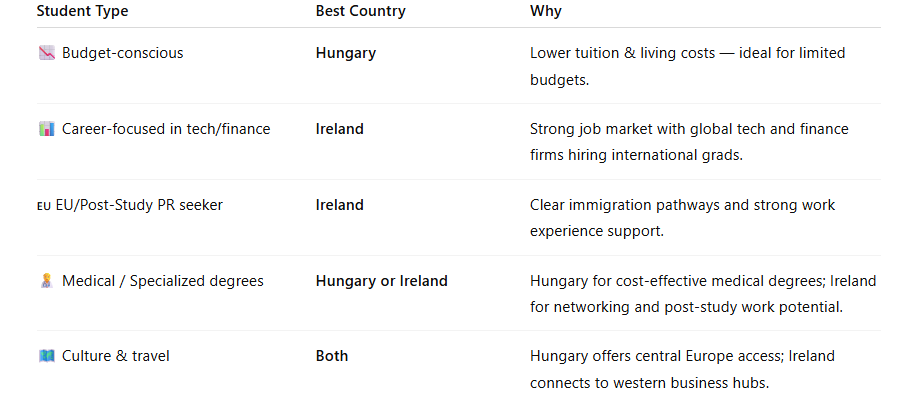
Final Verdict: Ireland vs Hungary in 2026
Both countries deserve serious consideration — but for different reasons:
Choose Ireland
if you want high‑quality education, strong work rights, and accessible paths to long‑term residency — and you’re prepared for higher costs.
Choose Hungary
if you are most concerned about affordability, manageable student budgets, and practical European experience with lower financial barriers.
Bonus Tips Before You Apply
✅ Plan finances early — prepare realistic budgets for tuition + living + flight + insurance.
✅ Prepare documentation thoroughly — Ireland especially checks financial proofs and language tests rigorously.
✅ Consider language skills — knowing Hungarian boosts job prospects; English fluency matters hugely in Ireland.
✅ Apply for scholarships early — both countries offer prestigious programmes that dramatically reduce costs.
Conclusion
Ultimately, there is no universal “better” choice — only the better choice for you. Ireland offers strong long‑term opportunities and career prospects with a clear path to residency, while Hungary gives you high‑value education at a low cost in the heart of Europe.
2026 looks like a promising year to study abroad, whether you choose the lush green campuses of Ireland or the historic universities of Hungary.