Best Countries to Study Abroad & Work in 2026: ROI (Return on Investment), PR Pathways & Post-Study Work Visas
Best Countries to Study Abroad & Work in 2026: A ROI & PR-Focused Guide
In 2026, studying abroad is no longer just about prestige or adventure—it’s a calculated investment. Students and families are asking smarter questions: What is the return on investment (ROI)? Will I be able to work after graduation? Is there a clear path to Permanent Residency (PR)?
With rising tuition costs and global competition, international students are prioritizing countries that offer affordable education, strong post-study work visas, and long-term immigration pathways.

This guide breaks down the best countries to study abroad in 2026, comparing post-study work rights, job opportunities, and PR pathways, while also highlighting emerging affordable destinations.
Why ROI & PR Matter More Than Ever in 2026
The global education landscape has shifted significantly:
- Tuition fees are rising in traditional destinations
- Students want faster returns through employment
- Immigration policies are becoming more selective
- Skilled worker shortages are shaping visa policies
As a result, the smartest students in 2026 are choosing destinations based on:
- Post-study work visa duration
- Employability and salary potential
- Ease of transitioning to PR
- Total cost of education vs earning potential
Top Study Abroad Destinations with Strong ROI
1. Canada – The Gold Standard for PR Pathways
Why it stands out:
Canada continues to dominate as one of the most student-friendly countries in the world.
Post-Study Work Visa (2026):
- Up to 3 years under the Post-Graduation Work Permit (PGWP)
PR Pathways:
- Express Entry system
- Provincial Nominee Programs (PNPs)
- High success rate for international graduates
Pros:
- Clear PR pathway
- High demand for skilled workers
- Strong job market in tech, healthcare, engineering
Cons:
- Rising cost of living
- Competitive immigration scoring system
Return on investment (ROI) Verdict:
Canada offers one of the clearest transitions from student to permanent resident.
2. United Kingdom – Fast Education, Strong Job Market
Post-Study Work Visa (2026):
- 2 years (Graduate Route)
- 3 years for PhD graduates
PR Pathway:
- Requires switching to a Skilled Worker Visa
- PR possible after 5 years of work
Pros:
- Shorter degree duration (3 years undergraduate, 1 year master’s)
- Access to global job markets
- Strong industries: finance, AI, healthcare
Cons:
- PR pathway is less straightforward
- High tuition fees
Return on investment (ROI) Verdict:
Good for quick entry into the workforce, but PR requires long-term planning.
3. Australia – Balanced Opportunity & Lifestyle
Post-Study Work Visa (2026):
- 2–4 years, depending on qualification and field
PR Pathway:
- Points-based immigration system
- Skilled Occupation List plays a key role
Pros:
- High salaries for graduates
- Strong demand in healthcare, engineering, IT
- Quality of life
Cons:
- PR can be competitive
- Tuition fees are relatively high
Return on investment (ROI) Verdict:
Strong ROI if you enter high-demand occupations.
Emerging Affordable Study Destinations (High Value, Lower Cost)
4. Germany – Nearly Free Education + Strong Job Market
Tuition Fees:
- Public universities offer low or no tuition fees
Post-Study Work Visa:
- 18 months to find a job after graduation
PR Pathway:
- PR possible after 2–4 years of work
Pros:
- Europe’s largest economy
- High demand for engineers, IT professionals
- Low education costs
Cons:
- Language barrier (German often required)
- Bureaucracy can be complex
Return on investment (ROI) Verdict:
One of the best ROI destinations globally due to minimal tuition costs.
5. France – Affordable Education with Growing Opportunities
Tuition Fees:
- Low compared to English-speaking countries
Post-Study Work Visa:
- Up to 2 years for master’s graduates
PR Pathway:
- PR possible after 5 years of residence
Pros:
- Affordable tuition
- Expanding tech and business sectors
- Increasing English-taught programs
Cons:
- French language often needed for jobs
- Competitive job market
Return on investment (ROI) Verdict:
Great for students seeking low-cost European education with career growth.
6. South Korea – Tech Hub with Rising Popularity
Tuition Fees:
- Moderate, with generous scholarships
Post-Study Work Visa:
- Job-seeking visa available after graduation
PR Pathway:
- Possible through long-term employment
Pros:
- Strong economy in tech, manufacturing, innovation
- High employability in STEM fields
- Affordable living compared to Western countries
Cons:
- Language barrier (Korean often required)
- Competitive job culture
Return on investment (ROI) Verdict:
High potential ROI, especially for tech-focused students.
Highest Paying Jobs for International Students in 2026
To maximize ROI, choosing the right field is just as important as choosing the country.
Top high-paying fields globally:
- Artificial Intelligence & Machine Learning
- Software Engineering & Data Science
- Healthcare (Nursing, Medicine, Allied Health)
- Engineering (Civil, Mechanical, Electrical)
- Finance & FinTech
- Cybersecurity
Students in these fields often secure:
- Faster employment after graduation
- Higher starting salaries
- Better PR opportunities
Cheapest Countries to Study Abroad in 2026
If affordability is your top priority, consider:
- Germany – near-zero tuition
- France – low public university fees
- South Korea – scholarships + moderate costs
- Eastern European countries – budget-friendly alternatives
These countries provide excellent education at a fraction of the cost compared to traditional destinations.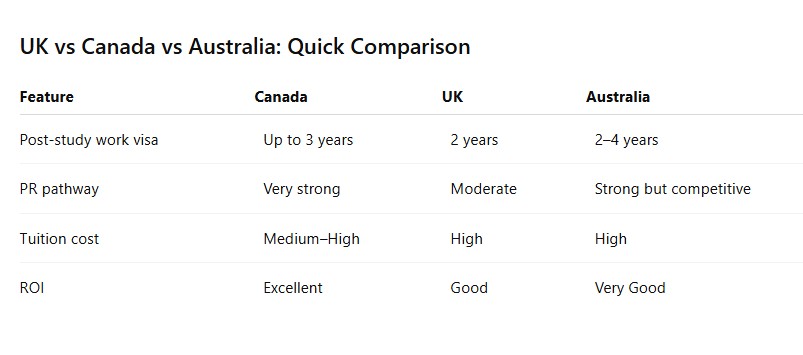
Final Thoughts: Choosing the Best Country for You
There is no one-size-fits-all answer. The best destination depends on your priorities:
- Choose Canada if PR is your top goal
- Choose the UK if you want quick degrees and global exposure
- Choose Australia for balance and lifestyle
- Choose Germany or France for affordability
- Choose South Korea for tech-driven careers
Conclusion
In 2026, studying abroad is a strategic decision. The smartest students are not just choosing where to study—they’re choosing where they can build a future.
By focusing on ROI, employability, and PR pathways, you can turn your international education into a long-term success story.